Part of: Telehealth Weight Loss · Choosing a program
Telehealth vs In-Person Weight-Loss Care: How to Choose
A brand-neutral comparison of online and in-person weight-loss care in the US: what the research shows, where each model is stronger, labs and monitoring, licensing and Medicare rules in 2026, FDA safety red flags, and questions to ask before you choose.

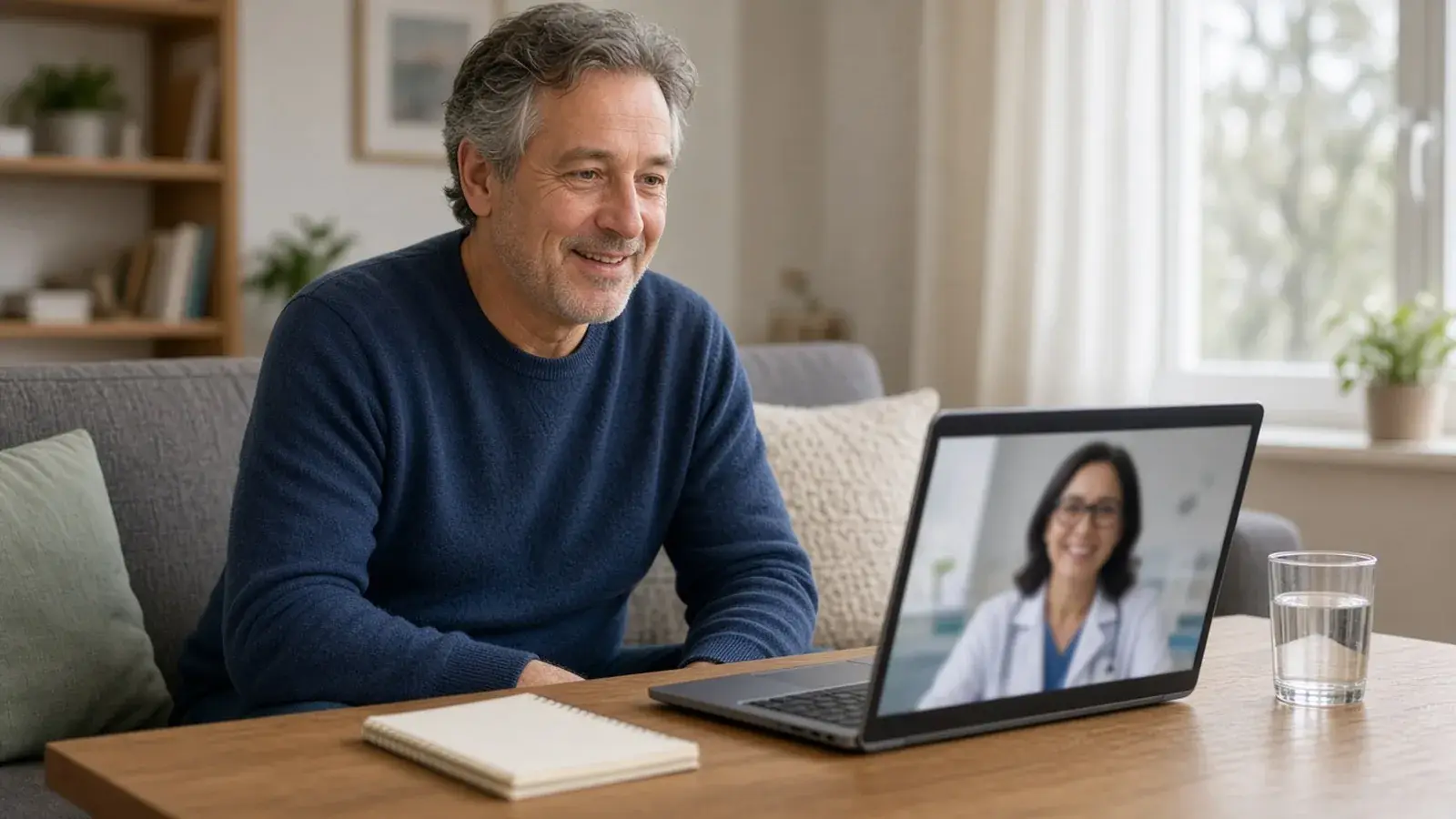
Not long ago, getting weight-loss treatment usually meant a trip to a clinic. Today you can be assessed, prescribed a medicine, and followed up without leaving home. That raises a practical question for anyone considering treatment: should you see someone in person, use a telehealth service, or combine the two?
Most of the people currently using GLP-1 medicines still get them through a regular doctor. In a KFF poll fielded in late 2025, 76% of people who had taken a GLP-1 said they got it from one of their doctors, about one in six (17%) from an online provider or website, and 9% from a medical spa or aesthetic center. But online care is now a mainstream route, and the right choice depends far more on your health and your needs than on which model is “better.”
This guide compares the two side by side, summarizes what the research shows, explains the 2026 rules that affect your options, and ends with questions to ask before you commit.
Educational only. This is not medical advice and does not endorse any program. Decisions about weight-loss treatment should be made with a licensed clinician who knows your health history.
The short answer
Neither option is automatically better.
- Research is reassuring but limited. Small studies comparing video-based and in-person weight programs have found similar weight loss. Large telehealth GLP-1 programs report meaningful results, but mostly from their own data without comparison groups.
- Telehealth is usually stronger on convenience: no travel, often faster appointments and more choice of clinicians, including specialists who are not near you.
- In-person care is usually stronger on examination and coordination: measured weight and blood pressure, a physical exam, on-site labs, and one team that sees your full record.
- A hybrid approach is common and often practical, for example in-person exams and labs with virtual check-ins in between.
- The safety basics are identical either way. A licensed clinician who reviews your history and can say no, a state-licensed pharmacy, real follow-up, and FDA-approved medicine unless there is a documented reason for a compounded one.
Side-by-side comparison
| Feature | Telehealth | In-person |
|---|---|---|
| Getting an appointment | Often faster; evenings and weekends common | Can involve waits, especially for specialists |
| Travel and time off | None | Travel, parking, time away from work or family |
| Choice of clinicians | Wider; any clinician licensed in your state | Limited to those near you |
| Physical exam | Not possible; visual only on video | Full exam available |
| Weight, waist, blood pressure | Usually self-measured at home | Measured by staff with calibrated equipment |
| Blood tests | Separate visit to a lab, or recent results shared | Often on-site or same building |
| Coordination with your other doctors | Varies; may be separate from your regular record | Easier if it is the same practice or health system |
| Complex conditions, many medicines | Possible, but harder | Generally better suited |
| Follow-up and messaging | Often frequent and easy | Varies by practice; portals help |
| Pharmacy | Often mail-order; check licensing | Local or mail-order |
These are general patterns, not rules. A well-run telehealth service can coordinate closely with your primary care doctor, and some in-person clinics are hard to reach between visits.
What “telehealth” and “in-person” actually mean
In-person weight-loss care can come from a primary care clinician, an obesity-medicine specialist, an endocrinologist, a hospital-based weight-management program or a bariatric surgery program. It may include a physician, a nurse practitioner or physician assistant, a registered dietitian and sometimes a behavioral health specialist.
Telehealth covers several formats. The US Department of Health and Human Services describes it as talking with a provider by phone or video, sending secure messages, and using technology to share information such as blood pressure readings. Some services also use online questionnaires reviewed later by a clinician, which is known as asynchronous care.
Hybrid care mixes the two. Many health systems now offer video follow-ups for patients they see in person, and many telehealth services send patients to local labs.
For a step-by-step walk-through of how online programs operate, see how telehealth weight-loss programs work.
What the research shows
The evidence comparing the two models directly is smaller than you might expect. Here is what we found.
Direct comparisons (mostly behavioral programs)
- A 12-week clinical trial in Saudi Arabia (2024) assigned 62 adults with obesity to either in-person clinic sessions or videoconference sessions covering goal-setting, eating habits, meal plans and physical activity. Weight, body fat and waist size fell significantly in both groups, with no significant differences between them. About 45% of the in-person group and 49% of the telehealth group lost more than 5% of their starting weight. Attendance was higher online (97% vs 75%), and dropout was lower (13% vs 21%).
- A US clinic study (2024) looked back at 139 patients referred for intensive behavioral therapy for weight management between 2019 and 2021, when many visits moved online. Weight loss was similar between those followed in person and by telemedicine, and loss to follow-up after the first visit was 27.4% in person versus 19.5% by telemedicine, a difference that was not statistically significant.
Both studies are small, and neither tested GLP-1 medicines. But they suggest the format of visits matters less than whether people keep attending.
The US Preventive Services Task Force reached a similar conclusion in its 2018 review of behavioral weight-loss programs. The effective programs it reviewed used group, individual, phone and web-based formats, and most had 12 or more sessions in the first year. The Task Force said differences between studies made it “difficult to identify the most effective intervention characteristics,” including “in-person vs remote sessions.”
Telehealth programs prescribing medicines
- A virtual weight-care program (2025) reported outcomes for 66,094 members prescribed a range of anti-obesity medicines alongside a digital behavior program. Average weight loss was 8.0% at 12 months, and 64.2% lost at least 5%. Members who engaged at least weekly lost more (10.0%), and those who logged their weight at least weekly lost 12.0%.
- A telehealth semaglutide cohort (2026) sampled 4,500 patients who started semaglutide through a national telehealth service. Among the 655 who reported a weight close to week 68, average weight loss was 16.6%. The most common side effects were nausea or vomiting (37.3%) and constipation (15.6%).
These results show that telehealth care can produce meaningful weight loss. They also have important limits. Both are observational studies of a single company’s program, with no in-person comparison group, and in the semaglutide study only about one in seven sampled patients had a usable weight at 68 weeks. People who stay in a program and keep reporting their weight may be the ones doing best, which can make results look better than they would for everyone who started.
Bottom line on the evidence: telehealth appears to be a workable way to deliver weight-loss care, and engagement seems to matter more than format. There is no large randomized trial comparing telehealth and in-person GLP-1 care head to head.
Where telehealth tends to be stronger
HHS lists the main benefits of telehealth in plain terms: you can see your provider from home, work or even your car, you save time “because you don’t need to travel, take time off, or find someone to watch your kids,” you “may get an appointment faster,” and you have more choices, including providers who may be far from you.
For weight care in particular, that can mean:
- Access where specialists are scarce. If there is no obesity-medicine specialist near you, a licensed clinician elsewhere in your state may be available online.
- Easier frequent follow-up. Short check-ins during dose changes are simpler when they do not require a trip.
- Higher attendance. In the small trial above, attendance was 97% online versus 75% in person.
- Less stigma for some people. Some patients find it easier to discuss weight from home.
- Built-in tracking. Many services ask you to log weight, symptoms and activity. In the 66,094-member study, people who logged their weight weekly lost the most.
Where in-person care tends to be stronger
Mayo Clinic’s overview of telehealth is direct about its limits: telehealth “runs the risk of gaps in care, overuse of medical care, inappropriate drug use or unnecessary care,” and providers “can’t do a physical exam in-person, which can affect a diagnosis.” For web or phone-based services specifically, Mayo lists these drawbacks:
- treatment may not be coordinated with your regular provider,
- important details from your medical history may not be considered,
- a computer-driven decision model may not be right for you if you have a complex medical history, and
- the service may not easily allow shared decision-making about treatment.
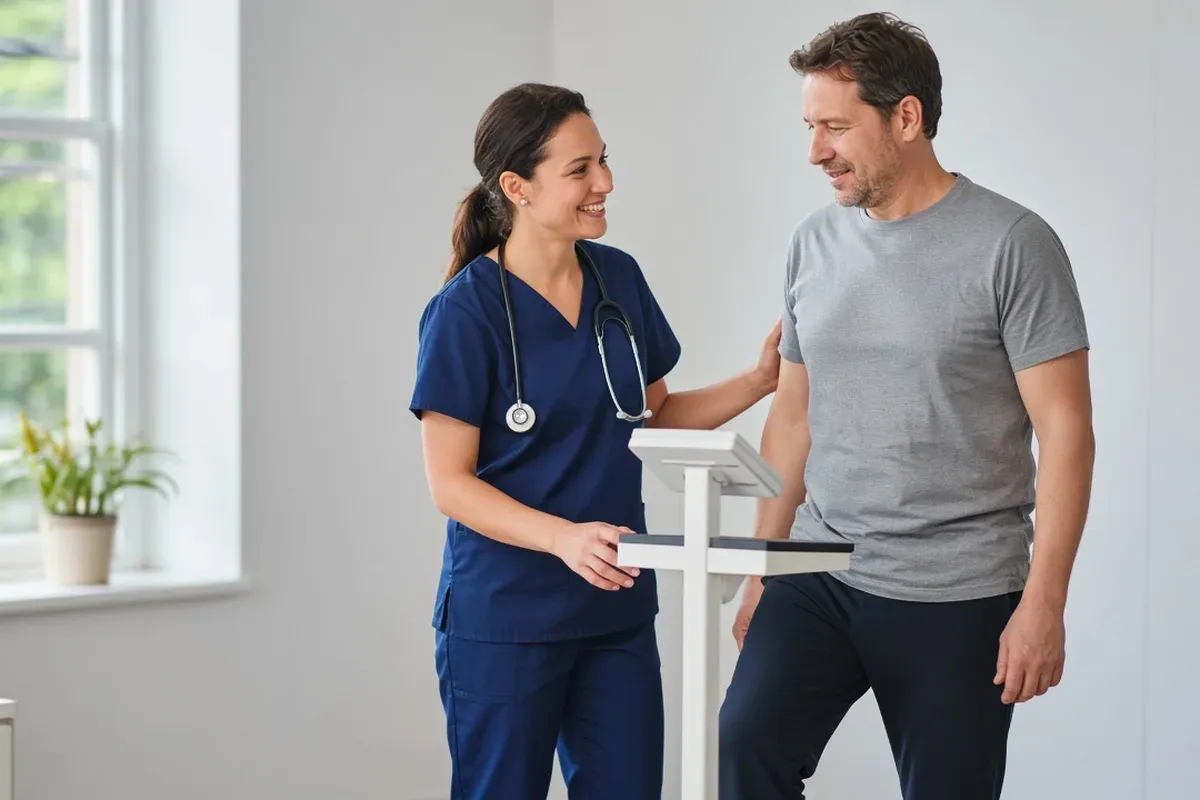
In weight care, in-person visits add several practical things:
- Measured numbers. National survey data show that self-reported height and weight are not identical to measured values, and that BMI calculated from self-reports tends to be lower than measured BMI. Eligibility for weight-management medicines depends on BMI, so an accurate measurement matters. If you use telehealth, a reliable home scale and an honest reading help.
- A physical exam, including blood pressure and heart rate taken by staff, and waist measurement. The Wegovy label, for instance, advises monitoring heart rate at regular intervals.
- Labs on site, and someone to act on abnormal results quickly.
- One record. If your weight-care clinician also manages your blood pressure, diabetes or other medicines, interactions and changes are easier to spot.
- Complex situations. People with type 2 diabetes treated with insulin or a sulfonylurea face a higher risk of low blood sugar when a GLP-1 is added, according to the Wegovy label, and may need dose changes in other medicines. A history of pancreatitis, gallbladder disease, eating disorders or kidney problems also calls for closer supervision.
Labs and monitoring: what to expect either way
Whether your care is online or in person, monitoring should continue after the first prescription. The details depend on your health and medicine, and are your clinician’s call. Examples from the Wegovy label include:
- monitoring blood glucose before and during treatment in people with diabetes,
- monitoring kidney function in people whose side effects, such as vomiting or diarrhea, could lead to dehydration, especially when starting or increasing a dose,
- monitoring diabetic retinopathy in people with type 2 diabetes, and
- monitoring heart rate at regular intervals.

Telehealth services typically handle this by ordering tests at a commercial lab near you, asking for recent results from your regular doctor, or asking you to use home devices such as a blood pressure cuff. If a program never asks about labs or vital signs, ask why. Our guide to how to get a GLP-1 prescription covers what a thorough first visit usually includes.
Safety checks that apply to both routes
The biggest safety risks are not about the format of the visit. They are about who is prescribing, which product is dispensed and where it comes from. FDA’s list of telehealth red flags for GLP-1 medicines says to watch for a company that:
- claims a compounded drug is the same as an FDA-approved drug,
- offers deep discounts or prices that seem too good to be true,
- sends medicine that looks different from what you have received before, or arrives broken, damaged or without instructions for use,
- “does not require a screening and prescription by a licensed doctor before providing medicine,”
- “does not have a licensed doctor available to answer questions after you receive your medication,” or
- has spelling errors, incorrect pharmacy addresses or a pharmacy name you think might be fraudulent.
FDA’s BeSafeRx guidance adds signs of a safe online pharmacy: it always requires a prescription, provides a physical US address and phone number, has a licensed pharmacist on staff, and is licensed with a state board of pharmacy.
On compounded GLP-1s specifically, FDA says they “are not FDA approved,” that the agency does not review them for safety, effectiveness or quality before marketing, and that they “should only be used in patients whose medical needs cannot be met by an FDA-approved drug.” FDA also recommends not using any injectable GLP-1 that arrives warm or with inadequate cold packs. These points apply whether a compounded product is prescribed online or in a clinic. For more, see our guide to how to spot unsafe online GLP-1 sellers, our Telehealth hub and Costs Without Insurance hub.
Rules that shape your options in 2026
Licensing: your location matters
Clinicians generally must be licensed, or otherwise legally allowed, to practice in the state where the patient is located. HHS describes the routes clinicians use to practice across state lines: a full license in each state, temporary practice laws, reciprocity between some neighboring states, licensure compacts and telehealth registration. It advises that “prior to an appointment, providers should verify patient location.”
The Interstate Medical Licensure Compact offers physicians a faster pathway to licenses in multiple states. As of October 2026, its website lists 39 states plus Washington, DC and Guam as full members processing applications, with several more joining. A compact speeds up licensing; it does not remove the need to be licensed where you are. You can look up a clinician’s license on your state medical board’s website.
Medicare telehealth through 2027
According to Telehealth.HHS.gov, recent legislation extended many Medicare telehealth flexibilities through December 31, 2027. Until then, Medicare patients can receive non-behavioral telehealth services at home, without geographic restrictions, and some services can be delivered audio-only. Coverage of the visit is separate from coverage of the medicine; see does insurance cover GLP-1s for weight loss? for Medicare drug rules, including the temporary GLP-1 Bridge.
DEA rules apply to some weight-loss drugs, not GLP-1s
Federal DEA rules for prescribing controlled substances by telehealth do not govern GLP-1 medicines, whose FDA labels list no controlled-substance schedule. They do matter for some older weight-loss medicines. Phentermine, for example, is a Schedule IV controlled substance. HHS says DEA’s temporary flexibilities, which let registered practitioners prescribe schedule II-V medicines by telemedicine without a prior in-person evaluation if conditions are met, run through December 31, 2026.
Insurance
Private insurers set their own telehealth and weight-medication rules, and many services operate on a cash-pay basis. Check whether a program accepts your insurance, whether the visit and the medicine are billed separately, and what happens if a prior authorization is denied. Our GLP-1 cost guide collects our cost articles.
Which might suit you better?
These are general patterns to discuss with a clinician, not rules.
Telehealth may be a good fit if you:
- are generally healthy apart from weight-related conditions such as high blood pressure or high cholesterol,
- have a recent physical and blood work, or can easily get labs locally,
- live far from specialists or have a schedule that makes clinic visits hard,
- are comfortable measuring your own weight and blood pressure, and
- are willing to keep your regular doctor informed.
In-person care may be a better fit if you:
- have several chronic conditions or take many medicines,
- have type 2 diabetes treated with insulin or a sulfonylurea,
- have a history of pancreatitis, gallbladder disease, an eating disorder, kidney disease or thyroid cancer in the family,
- need a physical exam, body-composition testing or close lab monitoring,
- want to explore all options, including surgery, with one team, or
- prefer face-to-face conversations.
A hybrid approach may suit you if you want in-person exams and labs at the start and at set intervals, with video or messaging check-ins for dose changes and side effects in between.
Eligibility rules are the same either way. Our guide to who qualifies for GLP-1 weight-loss treatment explains the label criteria.
Questions to ask before you choose
Of any program, online or in person:
- Who will review my history and prescribe, and what are their credentials? Are they licensed in my state?
- Will I speak with a clinician in real time, by video, phone or in person, before a prescription?
- Which labs or measurements do you require before and during treatment?
- Which medicine would you prescribe, and is it an FDA-approved product or a compounded one? If compounded, why?
- Which pharmacy fills the prescription, and is it state-licensed?
- How often are follow-ups, and how fast do you respond to side-effect questions?
- Will you share notes with my primary care doctor?
- What does it cost in total, including visits, medicine, labs and shipping, and how do cancellations work?
- What support do you offer for nutrition, physical activity and long-term maintenance?
- What is the plan if the medicine does not work, causes problems or I want to stop?
A program that answers clearly, asks you detailed questions and is willing to say “this isn’t right for you” is a better sign than one that promises a prescription within minutes.
The bottom line
Telehealth and in-person weight-loss care can both work. Small comparison studies show similar weight loss with video and in-person visits, and large telehealth programs report meaningful results, though with real limitations in how that evidence was gathered. Telehealth usually offers speed, convenience and choice. In-person care usually offers a physical exam, measured numbers, on-site labs and tighter coordination, which matter more the more complex your health is. Many people do best with a mix.
Whichever route you take, the essentials do not change: a licensed clinician who screens you properly, a prescriber licensed where you are, a state-licensed pharmacy, ongoing monitoring, and FDA-approved medicine unless there is a documented reason otherwise. Treatment also works best alongside good nutrition, strength training and a long-term plan for maintaining your results.
Explore more in our Telehealth Weight Loss hub and the GLP-1 Guide.
Frequently asked questions
Is telehealth weight-loss care as effective as in-person care?
The evidence so far suggests it can be, with caveats. A small 12-week clinical trial and a retrospective clinic study both found similar weight loss with video visits and in-person visits for behavioral weight programs, with attendance as good or better online. Large telehealth programs prescribing GLP-1s have reported weight loss of around 8% at 12 months and higher in some groups, but these were observational studies, often without comparison groups and with many people missing follow-up data. No large randomized trial has compared telehealth and in-person GLP-1 care head to head.
What are the main downsides of telehealth for weight loss?
The clinician cannot do a hands-on physical exam, weight and blood pressure are usually self-measured, and labs require a separate trip to a lab. Mayo Clinic also notes that web or phone services may not be coordinated with your regular provider, may miss details of your medical history, and may not suit people with complex medical histories. Some online sellers skip proper screening altogether, which FDA lists as a red flag.
When might in-person weight-loss care be the better choice?
In-person care may suit you better if you have several chronic conditions, take many medicines, have type 2 diabetes treated with insulin or a sulfonylurea, have a history of pancreatitis, gallbladder disease, an eating disorder or kidney problems, need a physical exam or body measurements, or want one clinician coordinating all your care. A hybrid setup, with in-person visits for exams and labs and virtual check-ins in between, is another option.
Do I need labs if I get a GLP-1 through telehealth?
Labs are a clinical decision for your prescriber, but many clinicians check baseline blood work such as blood sugar, cholesterol and kidney function before starting a weight-management medicine. The Wegovy label, for example, says to monitor blood glucose in people with diabetes and kidney function in people whose side effects could lead to dehydration. Telehealth programs usually arrange labs at a local lab or use recent results from your regular doctor.
Can an online clinician in another state prescribe a GLP-1 to me?
Generally, the clinician must be licensed, or otherwise legally allowed, to practice in the state where you are physically located during the visit. States offer several pathways, including full licenses, compacts such as the Interstate Medical Licensure Compact, temporary practice rules and telehealth registration. HHS advises providers to verify the patient's location before an appointment. You can check a clinician's license on your state medical board's website.
Does Medicare cover telehealth weight-loss visits in 2026?
Medicare's expanded telehealth flexibilities, including visits from home for non-behavioral care and audio-only visits in some cases, have been extended through December 31, 2027, according to Telehealth.HHS.gov. Coverage of the visit is separate from coverage of the medicine. Medicare drug coverage for weight-loss medicines follows its own rules, such as the temporary Medicare GLP-1 Bridge.
Are GLP-1 medications affected by DEA telehealth rules?
The DEA's telehealth rules apply to controlled substances. The FDA labels for GLP-1 weight-management medicines do not list them as controlled substances, so those rules do not govern them. They do apply to some other weight-loss medicines: phentermine, for example, is a Schedule IV controlled substance. DEA's temporary telemedicine flexibilities for controlled medicines run through December 31, 2026.
How do I check that an online weight-loss program is legitimate?
Use FDA's checklist. A legitimate program requires a screening and a prescription from a licensed clinician, has a clinician available for questions after you receive medicine, and uses a state-licensed pharmacy with a US address and a licensed pharmacist. Warning signs include claims that a compounded drug is the same as an FDA-approved one, prices that seem too good to be true, missing or misspelled labels, and medicine that arrives warm or damaged.
Sources
- Telehealth.HHS.gov: Why use telehealth? (updated July 29, 2025)
- Telehealth.HHS.gov: Licensing across state lines (updated April 30, 2025)
- Telehealth.HHS.gov: Medicare payment policies (updated February 5, 2026)
- Telehealth.HHS.gov: Prescribing controlled substances via telehealth (updated January 5, 2026)
- Interstate Medical Licensure Compact Commission (state participation, October 2026)
- Mayo Clinic: Telehealth: Technology meets health care (September 5, 2024)
- FDA: FDA's Concerns with Unapproved GLP-1 Drugs Used for Weight Loss (telehealth red flags)
- FDA BeSafeRx: Considering an Online Pharmacy?
- US Preventive Services Task Force: Weight Loss to Prevent Obesity-Related Morbidity and Mortality in Adults: Behavioral Interventions (2018)
- Alolayan RA et al. The Efficacy of Telehealth Versus In-Person Management Delivery in Adult Patients with Obesity. Healthcare (Basel) 2024 (PMC11545763)
- Latorre-Rodríguez AR et al. Adoption of telemedicine for obesity treatment during the COVID-19 pandemic achieved comparable outcomes to in-person visits. Obesity Pillars 2024 (PMC11405989)
- Clark JM et al. Long-Term Weight Loss Outcomes in a Virtual Weight Care Clinic Prescribing a Broad Range of Medications Alongside Behavior Change. Obesity Science & Practice 2025 (PMC11711220)
- Tchang B et al. Real-World Evidence on Weight Loss and Safety With Semaglutide in Obesity Telehealth: A Large Retrospective Cohort Study. Obesity 2026
- Flegal KM et al. Comparisons of Self-Reported and Measured Height and Weight, BMI, and Obesity Prevalence from National Surveys: 1999-2016. Obesity 2019 (PMC7289317)
- KFF: Poll: 1 in 8 Adults Say They Are Currently Taking a GLP-1 Drug (late 2025)
- FDA label: WEGOVY (semaglutide) injection and tablets, prescribing information (revised 06/2026)
- DailyMed: Phentermine hydrochloride tablets and capsules, prescribing information (Schedule IV)
Keep reading in Telehealth Weight Loss
- Red Flags: How to Spot Unsafe Online GLP-1 SellersA brand-neutral checklist for spotting unsafe online sellers of semaglutide, tirzepatide and other GLP-1 medicines: FDA's warning signs, what test purchases found, 'research use only' products, fake ads, how to verify a pharmacy and prescriber, and what to do if something seems wrong.
- How Telehealth Weight-Loss Programs WorkHow online weight-loss programs work in the US: how doctors decide whether you qualify, prescriptions and pharmacies, how refills and dose changes are handled, research results and FDA red flags.
See the full Telehealth Weight Loss hub →

Know someone who would enjoy this?